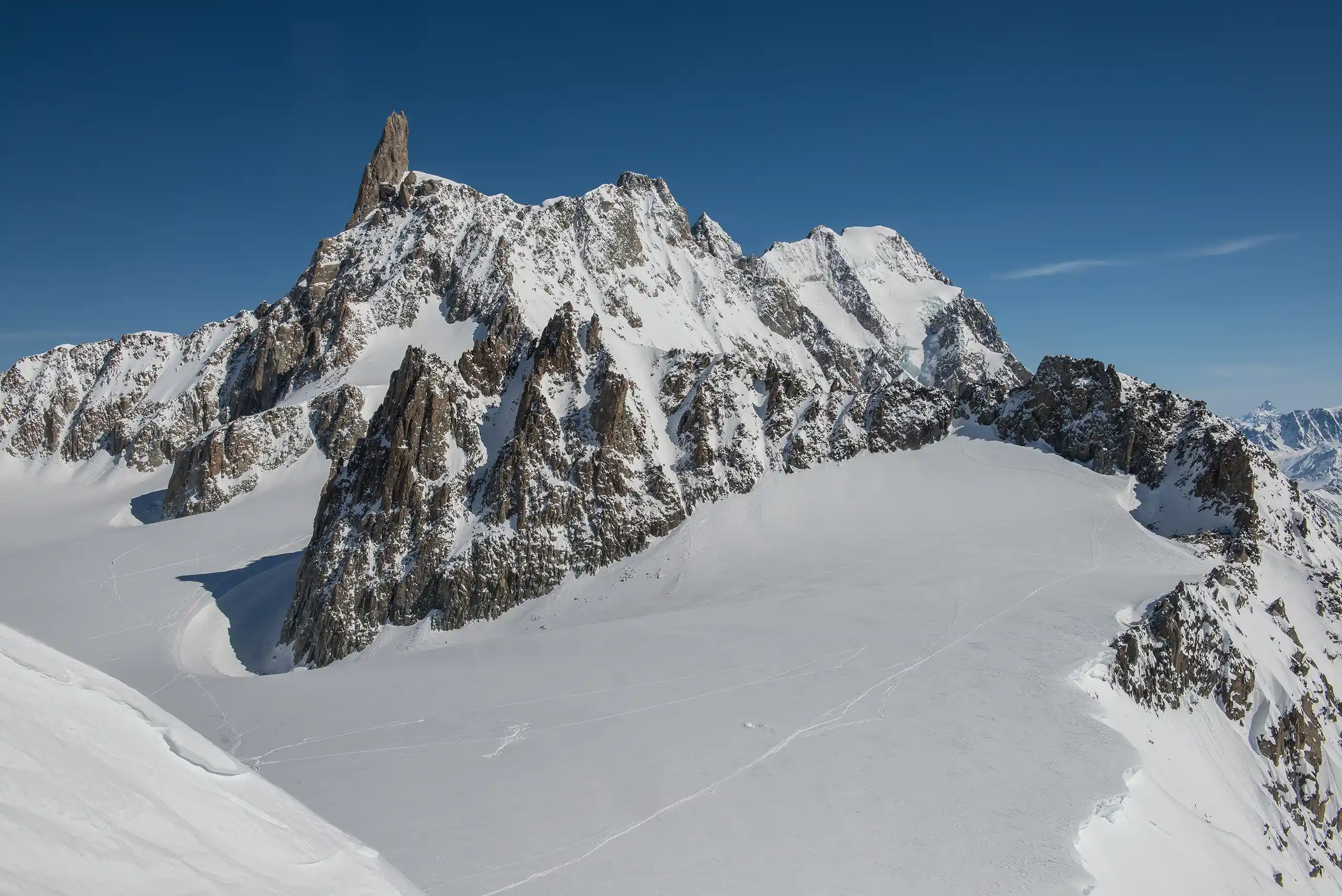
The “ Alpine Diamond”is a special FEDRE program for the Alpine region encompassing the Geneva-Lyon-Turin triangle (the French-speaking cantons of Switzerland, the Alpine departments and the Auvergne-Rhône-Alpes region, as well as the Piedmont and Aosta Valley regions), which we would like to expand. A dedicated website has been created for this initiative: diamant-alpin.org.
With the Alps and their highest peak in Europe before us, we stand before a symbol of nature, in a region that is unique in the world—despite the melting of glaciers caused by global warming. Its potential for sustainable development is considerable. Because of our altitude, we are more affected by global warming than other regions; we should therefore be able to raise public awareness more effectively and take steps to slow it down.
The “Alpine Diamond,” rooted in the natural Alpine landscape, its lakes, and its cities, draws its richness from its history and values. Located between Geneva, Lyon, and Turin, it also encompasses the Aosta Valley, Piedmont, and its capital, Turin—a model of industrial revitalization and exemplary cultural and entrepreneurial development.
The "Diamant Alpin" trademark has been registered by FEDRE with the World Intellectual Property Organization (WIPO) for a period of ten years in Switzerland, France, and Italy.
A new map of this region, in a new format (Crumpled Alps-Alpine Diamond-Mont Blanc), was unveiled at the first “Alpine Diamond Symposium” held in Courmayeur.
The Greater Geneva, Greater Lausanne, Greater Lyon, and Greater Turin areas, as well as the metropolitan areas of the Riviera, Evian, Thonon, Annecy, Chambéry, Annemasse, Grenoble, and Aosta—when viewed from the Americas or Asia—don’t really inspire people to stop there for a few days, let alone visit.
In contrast, an “Alpine Diamond” dominated by Mont Blanc and the French-Italian-Swiss Alpine range, bounded by a triangle formed by Lyon, Turin, and Geneva, enriched by its neighboring towns, lakes, and mountain resorts in both summer and winter, covering western Switzerland, the French Alpine departments, the Aosta Valley, and Piedmont—that speaks to an American or a traveler from Asia.
This magical space was the result of various discussions. A small Franco-Italian-Swiss group met on several occasions at the Mérieux Foundation on the shores of Lake Annecy, and sometimes in Lyon, Turin, or Geneva. We took stock of the heritage of each of our regions and realized that this space only reached its full potential when we approached it together. One day, on the paper tablecloth of a Lyon bistro, we drew three lines connecting Geneva, Lyon, and Turin. Then, marking the highest point at the center of this triangle, we drew three more lines to connect the corners. Looking at our drawing, we all said the word “Diamond” in unison.
“What ‘Diamond’?” we were asked. “Alpine,” replied the first person to be asked the question, speaking to a journalist. The “Diamant Alpin” was born. The core group—whose composition varied depending on the invitations it extended to enrich its discussions—had clearly expressed a desire: not to institutionalize it, but to make it a free platform connected to a wide range of local stakeholders, particularly those in the economic, cultural, scientific, academic, and political spheres.
In 1982, the group welcomed an American delegation composed of elected officials and specialists in regional planning and management. We introduced them to the “Alpine Diamond,” its major cities, and other equally fascinating towns, our Alpine sites, and our heritage in general, and we explained the purpose of our initiative, which was supported by our individual involvement in various bodies shaping the future of our region.
We clearly expressed our commitment to preserving our natural heritage by referring to the three pillars of sustainable development (economic, environmental, and social).
June 1994. A surprise. A letter from the U.S. government informed us that, based on information gathered about the “Diamant Alpin,” we had been awarded an honor recognizing the merit of this initiative and the way it was carried out, and that we were invited to Washington to receive it from the Secretary of Housing and Urban Development, former Mayor of San Antonio, Henry Cisneros!
So we traveled to the U.S. capital, where we were able to meet up with our counterparts from the organization Partners for Livable Places—now known as Communities—and once again share our experiences, hopes, and doubts.
This episode might be considered trivial. However, what really matters for the future is that, viewed from a distance of a few thousand kilometers, the Alpine Diamond is our true region. It is even unique in the world.