
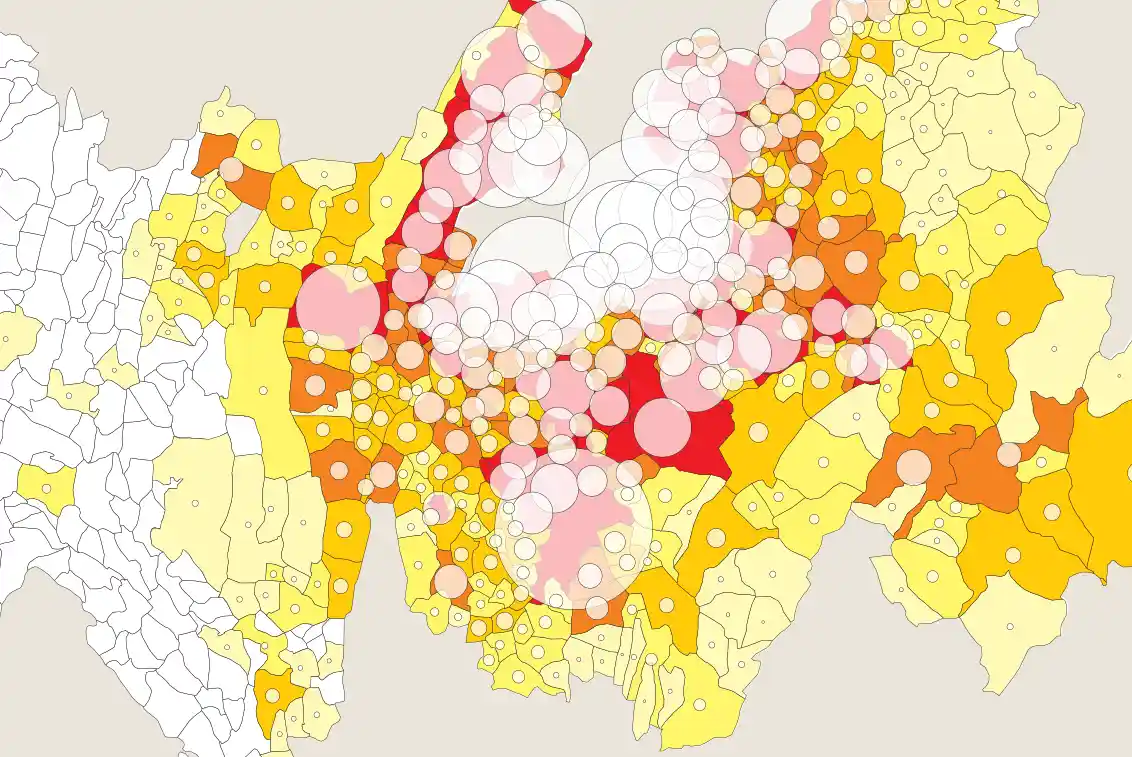
Under a 1966 agreement between Switzerland and France to prevent double taxation, the CFG allows the departments of Haute-Savoie and Ain and their border municipalities to recover 3.5% of the gross payroll of French cross-border workers. For 2021, the amount totals 326 million Swiss francs, or approximately 300 million euros.
Tax exchanges between France and Switzerland are based on cantonalized systems and are fragmented across various agreements tailored to the needs of specific regions. Such as the 1973 agreement between the Federal Council and the French government on the Geneva Financial Compensation (GFC), which followed a convention signed between the two countries in 1966 to avoid double taxation: Cross-border workers were thus taxed in the country where they worked, with the relevant canton transferring a portion of the payroll to the workers’ home cantons.
“The issue of taxation for cross-border workers is handled at the cantonal level and depends on various bilateral agreements with France,” confirms Anna Karina Kolb, Director of European, Regional, and Federal Affairs for the State of Geneva. The CFG is a local peculiarity. In fact, in the cantons of Vaud and Valais, the system works differently: cross-border worker status allows employees to be taxed only in France upon presentation of a certificate to their Swiss employer to avoid withholding tax. This is provided they return to France every evening and do not spend more than 45 nights per year in Switzerland.
Development aid
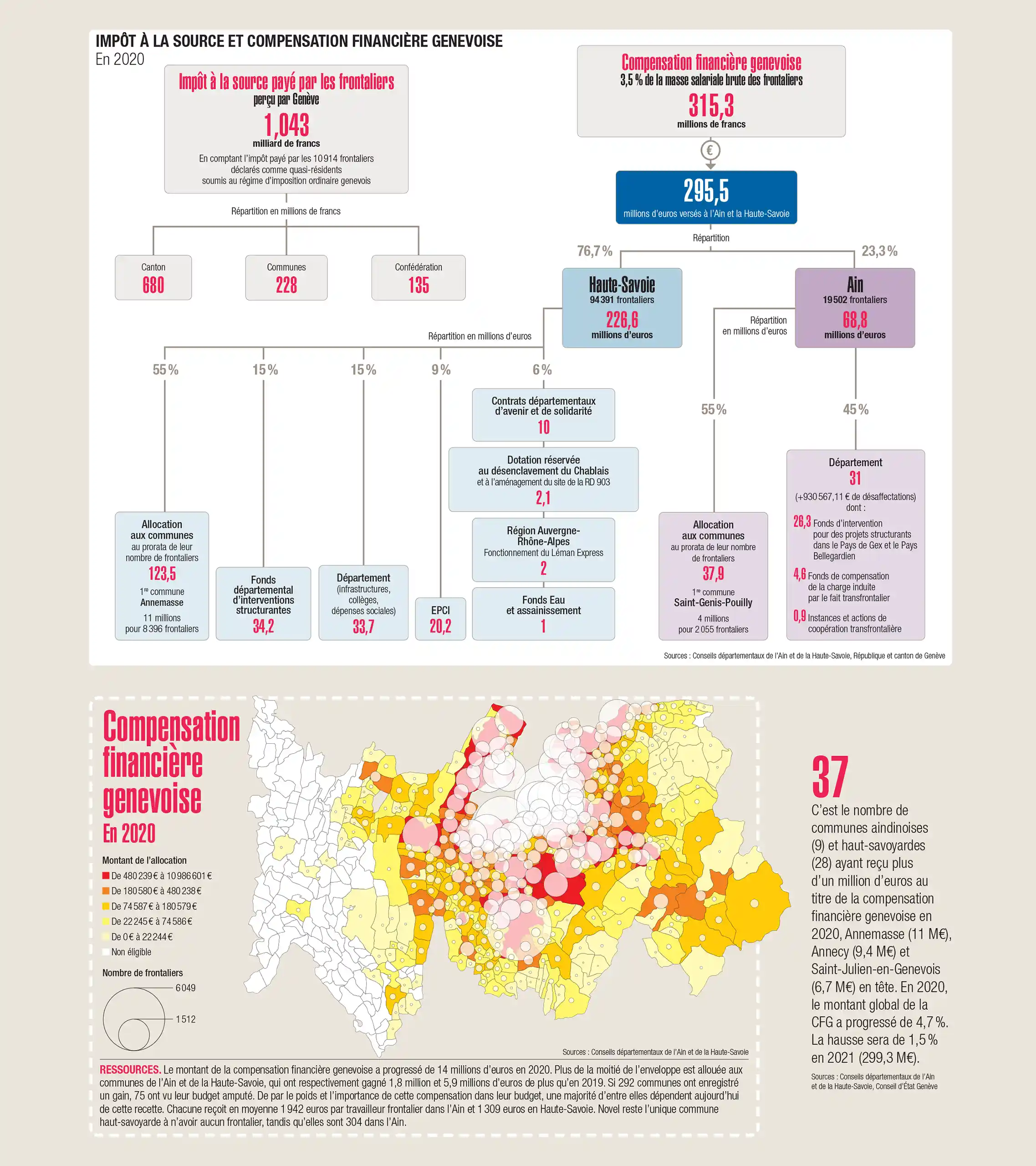
In June 2020, the Canton of Geneva had paid 315 million Swiss francs to the French Central Treasury Agency, which is responsible for distributing these funds among the departments of Ain and Haute-Savoie (accounting for 45% of the total) and their border municipalities, in proportion to the number of employees holding a G permit (and registered with their respective town halls). For 2021, the amount, up 3.4%, totals 326 million Swiss francs (approximately 300 million euros).
“Those who established the Geneva Financial Compensation Scheme were pioneers. It was a visionary tool at the time, and its value has become increasingly clear over the past few decades,” notes Anna Karina Kolb. “It remains essential for neighboring French communities to accommodate cross-border traffic and ensure the development of key infrastructure.”
As a result, Haute-Savoie was able to allocate, out of the 103 million euros received by the Department, 12 million euros to improving access to the Chablais region, €6 million to improving the rail network in the Arve Valley, €5.9 million for road improvement and development projects, €2 million for the department’s bike routes and greenways, 20 million euros for intermunicipal bodies such as the Annemasse-les-Voirons and Thonon-les-Bains urban communities.
In the Ain department, particularly in the Pays de Gex region, of the 31 million euros allocated to the Departmental Council, 6.4 million euros were used to fund the multi-year investment plan for this border region, 2.5 million euros for transportation operations, €2 million for the investment program of the Syndicat mixte des Monts Jura, €1.2 million to develop economic activity zones, and €1.3 million for social housing, among other things.
With the steady increase in the number of cross-border workers and the growing variety of tax statuses, the system must evolve regularly to meet the needs of French and Swiss regions. “Taxation is a sensitive issue, and certain aspects of it—such as those related to remote work—are currently under discussion,” summarizes Anna Karina Kolb.
Indeed, the COVID-19 pandemic has highlighted the complexity of this arrangement through the increased use of remote work, which is normally limited to 25% of total working hours. While this arrangement is currently being maintained due to health uncertainties, the question arises as to whether it will continue once the situation returns to normal. In that case, will cross-border workers be considered employees working for Switzerland while remaining in France, and where will they be taxed?
Sandra Molloy / Article published in the 2022 special issue *La Frontière en chiffres* of *L’Extension Diamant Alpin* magazine / November 2022