
Founded in Geneva in 1996 in association with the Council of Europe, FEDRE(www.fedre.org)has always focused on cross-border regions. In 2023, it formed a partnership with Crédit Agricole next bank to study the border effect in the regions surrounding Switzerland. Following Issue 1, which addressed food aid; Issue 2, which examined challenges in the healthcare sector; Issue 3, which presented a vital topic for our regions—water; Issue 4, which focused on culture; Issue 5, which tackled the sensitive issue of who compensates cross-border workers for unemployment; Issue 6 focused on the idea of a cross-border resident card, the next issue analyzed sustainable mobility in cross-border urban areas, Issue 8 was devoted to the European aspects of cross-border cooperation, Issue 9 to the diversity of tax systems for cross-border workers, Issue 10 to the difference between Switzerland and its neighbors in counting the unemployed, Issue 11 on the planning of sustainable transport infrastructure in border agglomerations, Issue 12 on the contribution of culture to a common cross-border identity, Issue 13 on the growing importance of border phenomena, Issue 14 on the role of sports in cross-border relations, Issue 15 on democracy in cross-border regions, Issue 16 on cross-border forest resources, Issue 17 on cross-border workers’ associations; we dedicate this 18th issue to reflections on the future of mobility, particularly in areas crossed by the border.
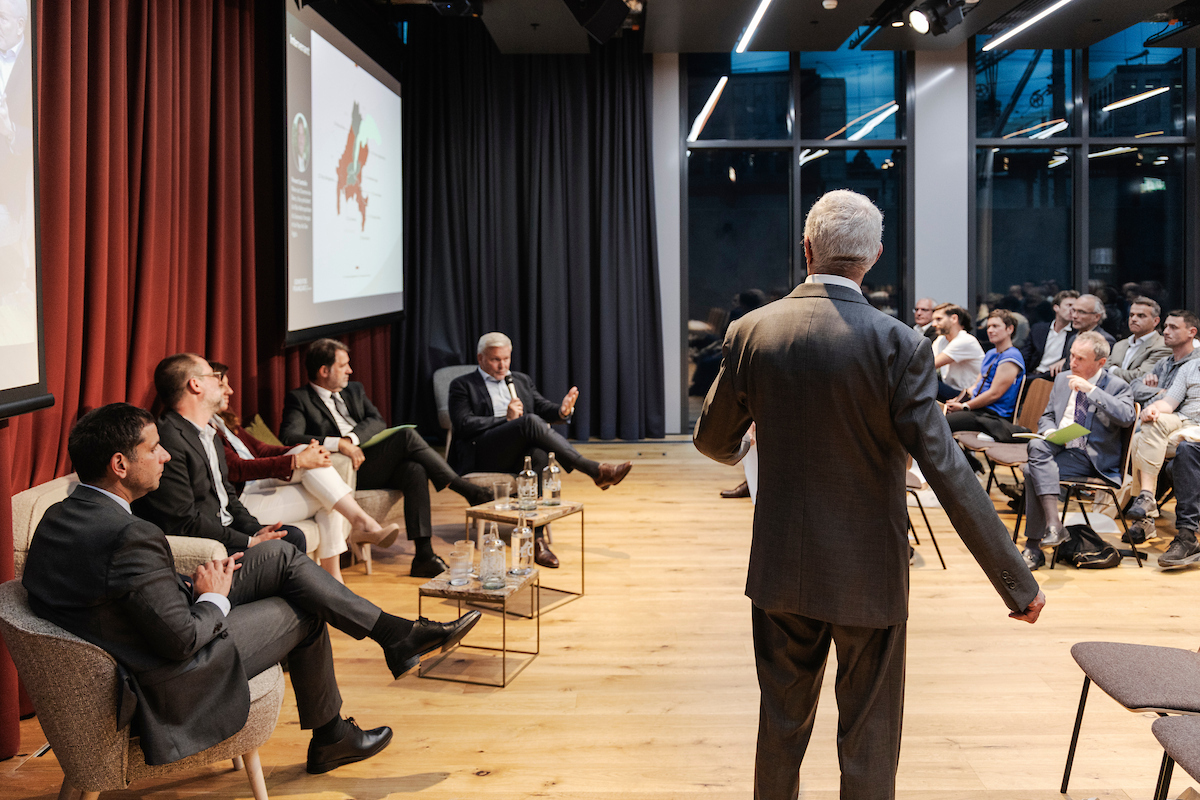
Mobility is a major issue of our time. We move around and aspire to do so, but with a growing awareness of the limitations this entails, and with an increasingly evident concern to do so in a sustainable manner by reducing harm to the environment and the climate. On May 19, 2025, the Swiss Confederation launched a “Microcensus on Mobility and Transportation” designed to collect data on the trips people make throughout the day. On the same day, by a happy coincidence, FEDRE and Crédit Agricole next bank organized a conference in Geneva on“The Mobility of Tomorrow,” followed by a roundtable discussion dedicated to this issue in the border region.
Be a visionary and demystify the automobile
Travel may be driven by work, school commutes, the need to shop for groceries or seek medical care, or leisure activities. It also applies to people with “reduced mobility.” Today, emphasis is placed on the importance of what is known as intermodality—that is, the complementary nature of different modes of transportation and the ability to use several of them (including walking) on a given route, without interruptions or excessive waiting times.
In his lecture on May 19, Daniel Goeudevert—a former president of Volkswagen and former head of Citroën, Renault, and Ford in Germany—stressed the need to put the automobile back in its proper place: simply one means of transportation among others, contrary to currentmarketing, which often sells it as an object of prestige or a dream, or even as a symbol of freedom (but what freedom do we have when we’re stuck in traffic?).
You also have to be a visionary, and Goeudevert was just that when, more than thirty years ago, he was already designing a prototype for an electric city car alongside Nicolas Hayek (the inventor of the Swatch and the Smart). But at the time, people weren’t ready for it—especially the engineers at VW and the financial partners. The result: Europe left the field open to the Chinese and Americans. He also failed to convince the Geneva Motor Show to transform itself into a Mobility Show, which might have saved it.
Mobility in cross-border regions
How can we promote mobility in a region divided by a border—an obstacle that does not exist in traditional urban areas?
David Favre, the cantonal director of transportation, emphasizes that Geneva, with 660,000 border crossings per day, has an infrastructure deficit that needs to be “made up for,” particularly by expanding the Léman Express service with a light rail system designed to carry 160,000 passengers per day by 2040. But it’s not just about catching up, counters Claude Haegi, President of FEDRE: we need to look further ahead and be able, following Goeudevert’s example, to shape the future while remaining committed to maintaining a human-scale urban area. Sabrina Cohen, President of the Nomads Foundation, agrees and hopes the issue will be addressed systematically: rethinking mobility as a whole and promoting multimodal transport by developing what she calls “micromobility hubs”—for example, at bus stops where bike stations could be installed—and ensuring that shared vehicles can cover most trips from point A to point B.
Christophe Castaner, president of the ATMB and former Minister of the Interior, also calls for a “rethinking” of our relationship with cars. Highlighting the ATMB’s commitment to carpooling and the environment, he advocates for “multimodal” travel in the cross-border region using “a single ticket” and sufficient park-and-ride facilities. Claude Haegi also points out that 41% of the Geneva bypass was built on French territory and paid for by France, thereby avoiding the destruction of valuable agricultural land in the canton of Geneva.
As director of the Léman Express, Mathieu Fleury set himself the goal of encouraging people to travel by train rather than by car. The success has exceeded expectations! Contrary to what is sometimes said, he emphasizes that the Léman Express was not created “for commuters” but for everyone, and that cross-border traffic accounts for only 25% of its ridership, with the remaining three-quarters consisting of trips within Switzerland and within France. The goal today is to increase frequency to bring it closer to what a metro system might offer, which requires acquiring additional rolling stock. The idea is that people should be able to arrive at the station “without having to worry about checking the schedule beforehand.” The success of the Léman Express clearly shows that a desire for a different kind of mobility is emerging, adds Vincent Scattolin, mayor of Divonne and vice-president of the Pays de Gex urban community. But its lines currently bypass the Pays de Gex. Ultimately, he believes, we must ensure that all areas are equally well-served, without focusing solely on commutes. He, too, advocates for a credible range of car-free travel options.
In conclusion, everyone expressed the hope that May 19, 2025, would be remembered as a milestone in the discussion of mobility in the Franco-Vaud-Geneva region.