

Toward a More Equitable Greater Geneva: FEDRE’s 10 Key Ideas — Article dated October 30, 2024, published in the Dauphiné Libéré
6 Minutes with François Saint-Ouen — Interview from October 30, 2024, broadcast on Radio Lac
Together, the Cross-Border Program — Broadcast on March 28, 2024, on Léman Bleu
6 Minutes with Claude Haegi — Interview from September 9, 2024, broadcast on Radio Lac

For several months now, the number of people receiving food aid has been steadily rising in Geneva and neighboring France. In Haute-Savoie, 25,000 people are relying on this aid. On the Geneva side, the figure stands at 15,000, primarily through the distribution of “Colis du cœur” food packages.
Although the region is prosperous, economic insecurity has been on the rise since the pandemic. We discuss this “border effect” with Claude Haegi, former State Councilor and president of FEDRE, as well as the directors of Partage and the Haute-Savoie Food Bank.
France 3 Auvergne-Rhône-Alpes program aired on March 23, 2024
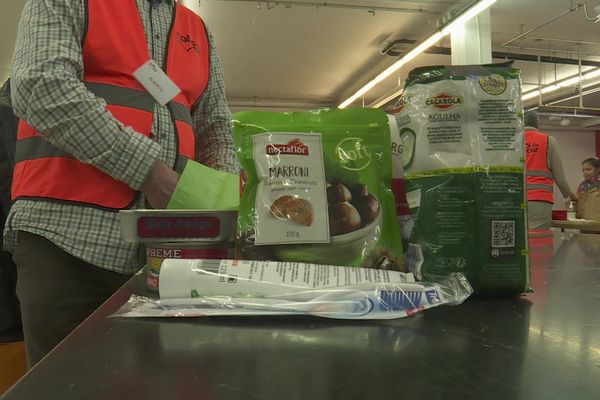
“We can’t live with pockets of poverty right on our doorstep!” Food insecurity is skyrocketing around Geneva
In recent months, food aid organizations along the French-Swiss border have seen the number of people they assist skyrocket. This record level of poverty is affecting the canton of Geneva and the department of Haute-Savoie to the same extent.
No matter which side of the issue you’re on, the situation remains concerning. In Switzerland and France, food insecurity is becoming increasingly widespread on the outskirts of the Geneva metropolitan area. Many residents are struggling to make ends meet and are relying on donations from food banks.
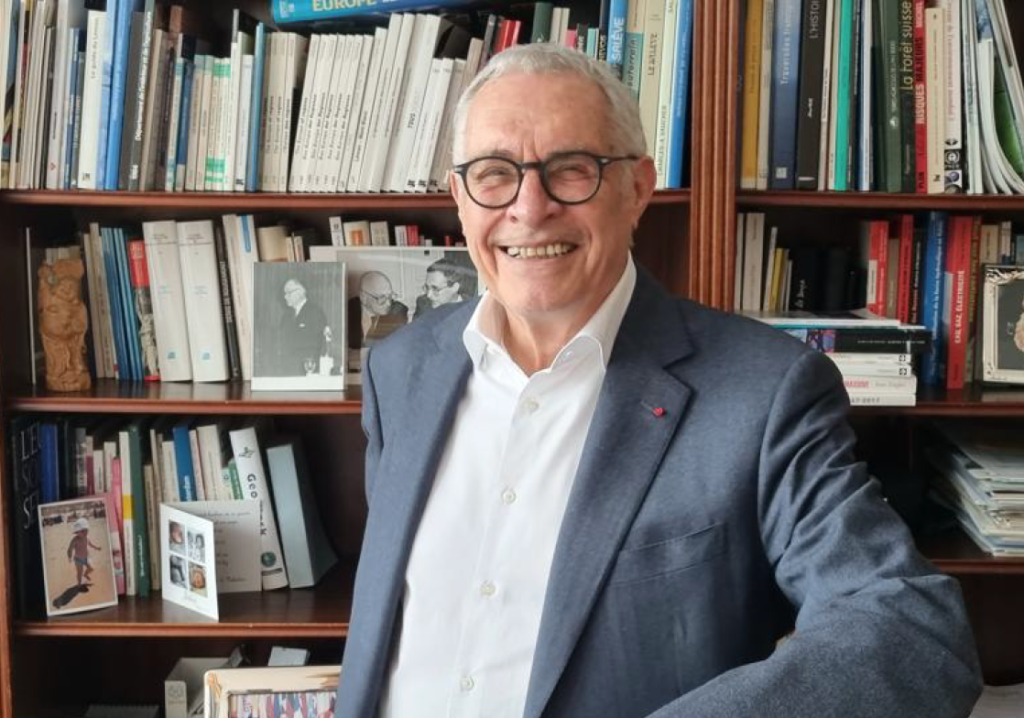
Claude Haegi: “My French friends, be ambitious when it comes to Geneva” | Interview published in *Le Dauphiné Libéré* on Sunday, January 14, 2024 | Interviewed by Sébastien Colson
Claude Haegi, a former center-right member of the Geneva State Council, has launched a study on the border effect, recognizing that the current development model also poses risks to social cohesion and prosperity in the greater Franco-Swiss region. With some thought-provoking ideas…
A first newsletter on food aid and poverty in the French-Geneva region. A second one on health. Former Geneva Minister Claude Haegi, who served on the State Council from 1989 to 1997, launched a specific study under the auspices of the FEDRE Foundation (European Foundation for the Economy and Sustainable Development of Regions) on cross-border relations throughout Switzerland, seeking to identify the “border effect.” While awaiting the overall results, here is the genesis of a project we will be following closely…
Where does this approach come from?
“Last year, on the50th anniversary of the tax revenue-sharing agreement between Geneva and neighboring French municipalities, I felt the need to move beyond this kind of backward-looking celebration and take a comprehensive look at the situation. Dangers are brewing. Inequalities are growing, and we’re sweeping them under the rug. During the recent60th anniversary of the Regio Basilensis, where we discussed cross-border relations across all of Switzerland, I once again observed the constructive spirit of the three partners—French, German, and Swiss. The people of Basel appreciate cross-border workers. Pharmaceutical companies have invested in production facilities, which also helps anchor the region within the European Union. Together with François Saint-Ouen, the Foundation’s Secretary General, we are gathering often unexpected testimonials. To spark reactions and dialogue, we are sharing insights from our survey, which we will compile into a final report. Only a transparent and realistic approach will allow us to move forward. At the cross-border workers’ fair, Pierre Maudet, Geneva’s Minister of Health, spoke plainly: “The difficulties are not insurmountable, but they are certainly complicated.” This is the right approach to finding solutions.”
Your first letter was about inequality…
“Yes. And at the Food Bank 74, they were very surprised that, as a regional organization, we were interested in a social issue. French cities near the border are among the most unequal in the country. That’s where you find the highest poverty rates! We can’t ignore this reality: prices are skyrocketing there, and local workers can’t keep up. The Haute-Savoie Food Bank helps 21,000 people out of 850,000 residents, while the one in Geneva helps 14,000 out of 515,000 residents—it’s the same proportion. Surprising! Equity is a key word. And in the region, there are people who are clear-sighted enough to realize that this poses real social dangers.”
What topics will you be covering next?
“We systematically address the issues that shape the daily lives of the region’s residents by focusing on the components of sustainable development. This includes the economy—with employment and training—the environment—with biodiversity, the timber and water sectors—and quality of life and social issues in general, including the critical issue of health. Let’s not just react to events! Let’s build together, innovate, and rebalance the potential on both sides of the border. The cultural sector lends itself well to this. I have long dreamed of a cultural center on French territory that has the appeal of the Gianadda Foundation in Martigny—a destination that would be a must-see for anyone passing through. French friends, challenge Geneva with ambitious projects! Together, we’ll be even more attractive. We can also draw inspiration from the Regio Basilensis with its cross-border cultural pass and university programs.”
Claude Haegi: “Let’s Talk About the Border Effect” | Column published in Entreprise romande on Monday, May 27, 2024
The Foundation for the Economy and Sustainable Development of Europe’s Regions (FEDRE), established in Geneva in 1996 with the support of the Council of Europe, has launched—in partnership with Crédit Agricole Next Bank—a specific study of cross-border relations throughout Switzerland, seeking to identify what it calls the “border effect.” It addresses all topics, even those receiving the least media coverage, in an effort to provide a comprehensive overview. The idea for this project emerged last year during a symposium organized to mark the50th anniversary of the tax revenue sharing agreement between Geneva and France.
Originally, the plan was to conduct an audit of these relationships, but in consultation with Crédit Agricole, we decided it would be useful to cover the entire Swiss border region in order to provide points of comparison that are too rarely taken advantage of. The topics covered include food aid, the alarming rise in poverty in border regions, health, water and Lake Geneva, culture, and the payment of unemployment benefits to cross-border workers.
The following areas, in particular, will be examined in the near future: the environment, mobility, research, business, prices, real estate and housing, land use planning, education, and resources. We must not shy away from addressing certain sensitive issues that are not discussed enough. In Basel, Geneva, and the Jura Arc, cross-border cooperation has undoubtedly made undeniable progress. But certain successes can give rise to new, unforeseen problems. FEDRE has shone a spotlight on the rise in poverty in the Geneva region and in Geneva itself, alerted by the Partage Foundation and the Haute-Savoie Food Bank: fifteen thousand people in the canton and twenty-five thousand in Haute-Savoie—representing roughly one in thirty-five residents—depend on food aid. According to official statistics, the three French intermunicipal communities around Geneva have become the most unequal in all of metropolitan France and the overseas territories! It is a social time bomb on our doorstep.
Similarly, in the healthcare sector, the situation has become untenable: medical care is no longer being provided in neighboring France due to a shortage of staff, while in Geneva, the HUG relies on 50% cross-border workers, and even more in the private sector. What will happen if the border has to close, as nearly happened during the pandemic? A fundamental rebalancing is necessary. We must not limit ourselves to a single territory like Greater Geneva, but rather apply a flexible approach tailored to the problems at hand. We must turn a new page in cross-border relations so that they benefit as many people as possible without undermining the economic dynamism that is the region’s strength. All of this will require a great deal of commitment from both sides in the search for innovative solutions.
But it's worth it.