
Founded in Geneva in 1996 in association with the Council of Europe, FEDRE(www.fedre.org)has always focused on cross-border regions. In 2023, it formed a partnership with Crédit Agricole next bank to study the border effect in the regions surrounding Switzerland. Following Issue 1, which addressed food aid; Issue 2, which examined challenges in the healthcare sector; Issue 3, which focused on a vital issue for our regions—water; Issue 4, which explored culture; Issue 5, which tackled the sensitive topic of who compensates cross-border workers for unemployment; Issue 6 focused on the idea of a cross-border resident card,the next issue analyzed sustainable mobility in cross-border urban areas, Issue 8 was devoted to the European aspects of cross-border cooperation, Issue 9 to the diversity of tax systems for cross-border workers, Issue 10 to the difference between Switzerland and its neighbors in counting the unemployed, Issue 11 on the planning of sustainable transport infrastructure in border agglomerations, Issue 12 on the contribution of culture to a common cross-border identity, Issue 13 on the growing importance of border phenomena, Issue 14 on the role of sports in cross-border relations, Issue 15 on democracy in cross-border regions, Issue 16 on cross-border forest resources, Issue 17 on cross-border workers’ associations, Issue 18 on the future of mobility, particularly in border areas, Issue 19 on “Greater Geneva”… and here is Issue 20 on agriculture in the Franco-Geneva region.
Along with the “free zones”—which have been somewhat forgotten today—agriculture has historically played a decisive role in fostering cross-border cooperation in the Franco-Geneva region.
They still have an impact, albeit a lesser one. And there are unresolved issues that the region’s agricultural communities—primarily those in Geneva—are trying to bring to light. This warrants a brief look.
Yesterday's landscape
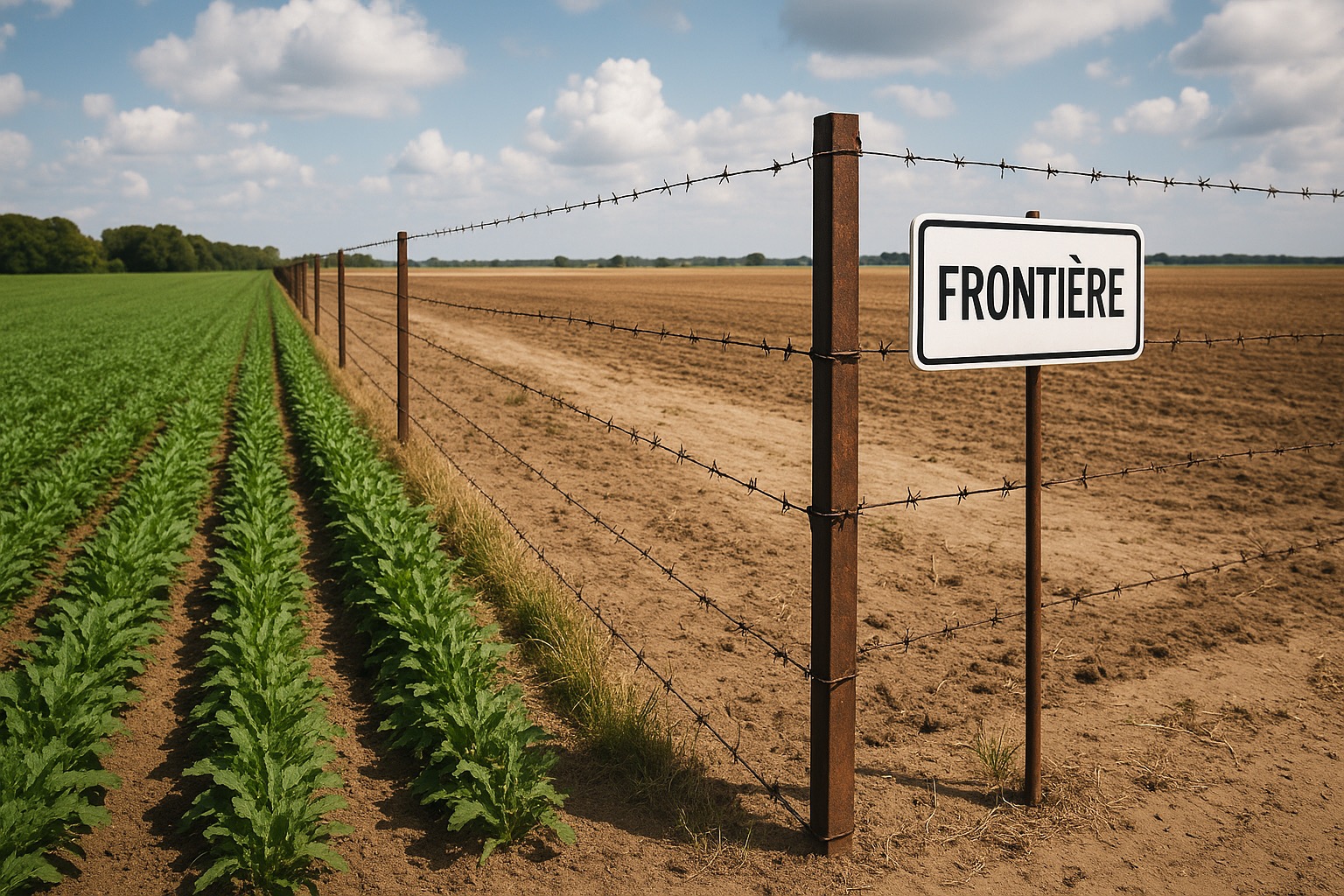
Following Napoleon’s defeat, Europe was redrawn through a series of treaties, including the Treaties of Paris in 1815 and Turin in 1816, under which France and Piedmont-Sardinia agreed to cede a number of municipalities (the “united municipalities”) to the Canton of Geneva in order to unify its territory. The Treaty of Turin also provided (Art. 3) for the creation of a150-square-kilometer free zone, with customscontrolsmoved back to its boundaries, allowing Geneva residents to shop there and producers in the zone to sell their goods—primarily agricultural products—in Geneva. When Savoy was annexed to France in 1860, this zone was even expanded (the inhabitants of northern Savoy had unanimously voted “Yes + Zone” in the referendum). But after World War I, in the climate following the victory, a French law abolished it in 1923 based on a provision of the Treaty of Versailles (Art. 435) and a Franco-Swiss compromise of 1921… ...which the Swiss people rejected in 1923, leading to a lengthy arbitration process between the two countries. The outcome, decided in Territet in 1933, was the retention of the zone in a smaller form.
This cooperation on goods historically preceded the 1973 agreement on cross-border employment, which launched the current cooperation process. However, with the completion of the EU’s Internal Market, followed by the entry into force of the free movement agreement with Switzerland in 2002, and finally the expansion of the Schengen Agreements in 2008—which led to the dismantling of customs checkpoints at the zone’s borders—the agreement lost much of its substance.
Today's mixed picture
Food products from the free zones, which cover approximately 550km²(350 in the Pays de Gex and 200 in Haute-Savoie), now bear the Swiss origin label established in 2017. However, federal lawmakers were prepared to exclude them; yet a campaign by French and Genevan farmers, supported by the cantonal government, prevented this from happening. This does not concern only the French, as it is worth noting that approximately 70 Genevan dairy farmers and a dozen vegetable growers have farms in the free zone. It is also known that, for a long time, Laiteries Réunies de Genève has been distributing products from the free zone. It should also be noted that the Genève Région – Terre d’Avenir (GRTA) label, created by the canton in 2004, extends to vegetable products from the free zone.
Does this mean all issues have been resolved? According to AgriGenève, the Geneva-based umbrella organization, attention should be drawn to certain unresolved problems. Obviously, the price differential penalizes Geneva farmers, whose products are inevitably more expensive than those of their neighbors. Similarly, there is the deeply ingrained habit of many consumers in the canton (some out of economic necessity, but not all) who usually shop for groceries in neighboring France.
We should also mention the approach taken by Geneva’s local authorities, which source their supplies en masse through purchasing platforms, prioritizing the lowest price over local sourcing. Beyond the purely economic aspect, one might argue—as AgriGenève does—that this contributes to the disconnection from agriculture and the farming profession. The State Councilor has ensured that the cantonal hospital (HUG) changes its purchasing policy for poultry, and we hope that similar measures can be taken, particularly for school cafeterias and university dining halls.
Furthermore, there are a few cases where overly rigid regulations—especially when applied without regard for the context—create Kafkaesque situations. For instance, following the land swaps resulting from the airport’s expansion, some farmers in Soral found that parts of their land had become French territory. However, the federal customs administration refuses to allow farm vehicles to be parked in France. It therefore wants these farmers to abandon their tractor sheds, located in the middle of their farms just 200 meters across the border. They are now forced to demolish them, with very limited possibilities of rebuilding them in the canton, due to the Federal Act on Spatial Planning (LAT)!
It is also worth noting that it was decided that direct payments made by the Federal Office for Agriculture to farmers would be limited to production carried out solely within Swiss territory (yet a number of farmers in Geneva have farms in the free trade zone). Federal customs authorities also show a complete lack of flexibility, requiring, for example, that a hay transport must be pre-registered to be assigned a specific two-hour time slot—and no more. And if the harvest—and thus the transport—could not take place within the scheduled time frame due to weather conditions, a new request must be submitted; otherwise, the fine is substantial!
These are just a few of the many issues that will need to be addressed.